Introduction to Serverless Scalability
Serverless architecture is transforming how modern organizations design, deploy, and scale applications. Instead of manually maintaining servers or infrastructure, serverless computing allows developers to run code on-demand, automatically scaling resources as application workloads grow. This serverless approach to scalability ensures that businesses can deliver reliable services, reduce operational costs, and accelerate the development life cycle. Organizations adopting serverless models are seeing not only immediate cost savings but also major improvements in agility, productivity, and resilience.
Understanding Serverless Architecture
Core Concepts
At the heart of serverless computing are several key concepts:
- Function as a Service (FaaS): Code is broken into small, independent functions triggered by events.
- Event-Driven Architecture: Functions respond to events from applications, APIs, or data streams.
- Automatic Scaling: Applications seamlessly expand or shrink resources depending on demand.
- Pay-Per-Use Pricing: Businesses only pay for the execution time and resources consumed.
- Managed Services: Infrastructure, scaling, and updates are abstracted by the cloud provider.
These principles collectively define why serverless architecture for scalability is becoming mainstream in cloud-native environments.
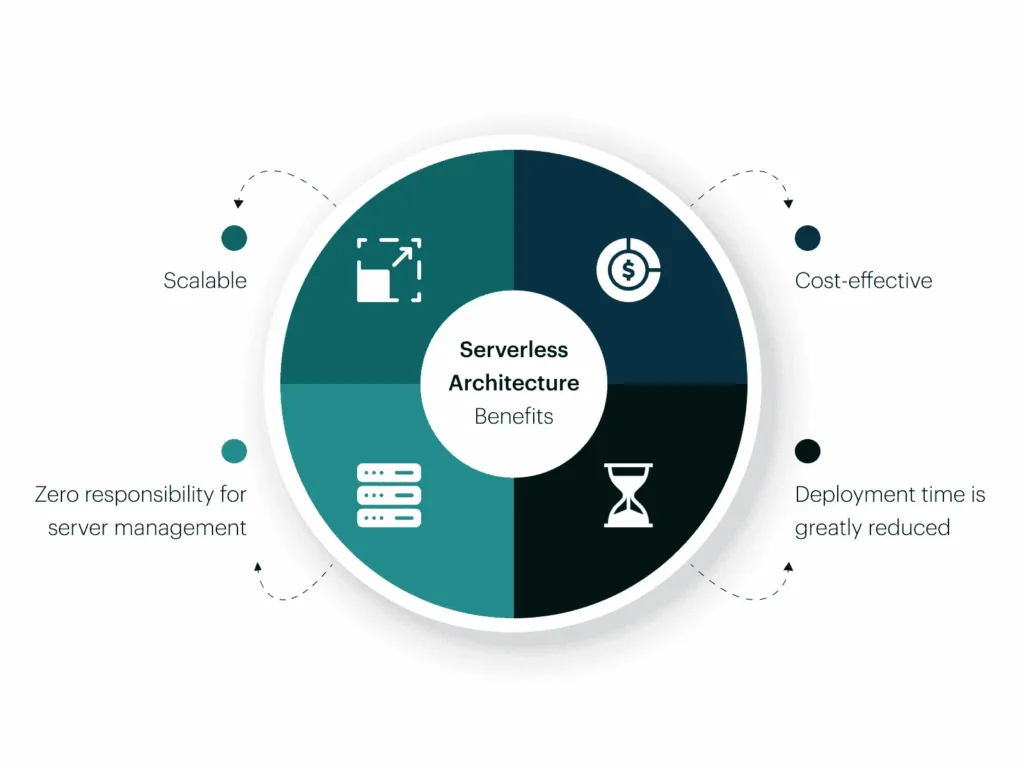
Benefits of Serverless
The main advantages of adopting serverless for scalable applications include:
- Automatic scaling: Applications handle unpredictable traffic without manual adjustments.
- Cost optimization: The pay-per-use model avoids over-provisioning of resources.
- Reduced maintenance: Server management, patching, and scaling logistics are delegated to the provider.
- Faster deployment: Functions can be launched quickly with minimal setup.
- Improved reliability: Built-in redundancy ensures fewer outages and downtime.
Implementation Strategies
Application Design
To leverage scalable serverless design, organizations must plan around:
- Function granularity (breaking code into manageable, reusable units).
- Event handling for different triggers such as HTTP requests or file uploads.
- Effective state management, ensuring distributed systems maintain consistency.
- Performance optimization and error handling to protect user experience.
Infrastructure Setup
Implementation requires:
- Selecting a reliable cloud provider such as AWS, Azure, or Google Cloud.
- Proper security setup and compliance readiness.
- Monitoring tools for performance and cost oversight.
- CI/CD pipelines for faster testing and deployment of functions.
Technical Considerations
Function Design
When building serverless functions for large-scale applications:
- Keep functions stateless to enable faster scaling.
- Manage timeouts and handle failed executions.
- Allocate resources based on workloads while preventing overuse.
- Use strategies to reduce cold start latency.
Integration Patterns
Applications often integrate serverless resources with:
- API Gateways for routing traffic.
- Event sources such as queues or databases.
- Microservices and containerized backends.
- Authentication services for secure access.
Best Practices
Performance Optimization
Improving performance in serverless applications often requires:
- Optimizing functions to reduce execution time.
- Using caching layers and content delivery networks.
- Reducing cold starts with provisioned concurrency.
- Managing connections effectively for databases and external APIs.
Cost Management
For organizations, serverless cost optimization is a priority:
- Monitor usage with provider dashboards.
- Implement budgets and alerts to track expenses.
- Reserve capacity for predictable workloads.
- Continuously review function design to eliminate inefficiencies.
Use Cases
Web Applications
Serverless computing is highly effective for:
- Real-time APIs for mobile and web backends.
- Scalable e-commerce and SaaS platforms.
- Real-time event processing such as payments or chat.
Enterprise Solutions
- Data analytics: Process large volumes of data with serverless functions on demand.
- Microservices architecture: Build modular applications that grow independently.
- IoT applications: Handle millions of sensor events cost-effectively.
- Batch processing: Automate workloads for schedules or data ingestion.
Implementation Challenges
Technical Challenges
- Cold starts can impact latency for time-sensitive apps.
- Resource and execution limits may restrict intensive tasks.
- State management complexity increases as applications grow.
- Debugging distributed functions requires advanced monitoring.
Operational Challenges
- Cost management may spiral if monitoring is weak.
- Performance monitoring needs accurate metrics collection.
- Security and compliance responsibilities remain critical.
- Teams require training to adopt new serverless scalability models.
Case Studies
For example, an e-commerce business migrating to serverless architecture reported:
- 60% cost reduction due to optimized pay-per-use billing.
- 40% faster deployment through automation.
- Improved reliability and built-in disaster recovery.
- Enhanced security from cloud-managed compliance frameworks.
Future Trends
As serverless evolves, organizations can expect:
- Tighter integration with edge computing for low-latency services.
- Built-in AI/ML capabilities for analytics and automation.
- More advanced multi-cloud support tools.
- Continuous improvements in real-time monitoring and serverless security.
Conclusion
Serverless architecture is no longer just a niche solution—it represents the future of cloud scalability. By enabling automatic scaling, optimizing costs, and delivering resilient performance, serverless computing empowers organizations to focus on innovation rather than infrastructure. Companies that carefully design functions, monitor usage, optimize costs, and address challenges will see significant ROI. The combination of scalability, agility, and security makes serverless architecture one of the most powerful strategies for dependable digital transformation in 2025 and beyond.